

Showing posts with label Purple Sandpiper. Show all posts
Showing posts with label Purple Sandpiper. Show all posts
Sunday, May 20, 2018

Friday, February 10, 2017
Supposed to be sunny but cloudy - Risavika, Sele and Granebukta
I took a day off Friday on the expectation that it'll be sunny in the morning and only cloudy towards the end of the day. At least half of the day promised to be bright for some decent bird photography. However as far as Stavanger goes, if it doesn't rain it's already more than one can ask for. And it didn't rain, it was cloudy and the birding wasn't too bad. Blueskies was asking too much.
My first stop was Risavika Havn, approximately 30 mins from home. There were rafts of Goldeneyes and Mallards far across the bay. About 20-25 Grey Heron in flight spooked by a big raptor which I couldn't identify. And there they were two seals in the water right in front of my set-up ... which quickly answered my question as to why the ducks were so distant today as opposed to a couple of weeks back.
I have been to this spot several times over the years, Common Scoter, Velvet Scoter, Grey Heron, Mute Swan, Common Widgeon, Mallard, Cormorant are the usual suspects spotted around the bay. The herons actually roosts on the trees and rocks on little islands nearby. The seals too have been spotted before in the bay. On this session I also saw a pair of Redbreasted Merganser foraging close to shore. These birds are not usually present in big numbers but enough to sustain a birder's interest, well mine at least.


I think the best from this spot are the sea ducks ... both the Velvet Scoter (Melanitta fusca) and the Common Scoter (Melanitta nigra). They too are not present in great numbers however those that are present which usually number less than ten individuals afford very close views especially for photography without any elaborate hides and what not. They are usually scattered over the small bay, but always one or two close to shore.
There are times when one or two curious individuals (ducks) would come quite close for great views on the 600mm lens coupled with a 1.6 crop factor camera. Normally they are far at the start, but once you are settled in, one or two would make a close swim by feeding and foraging along as it does so, definitely within a 10m range.


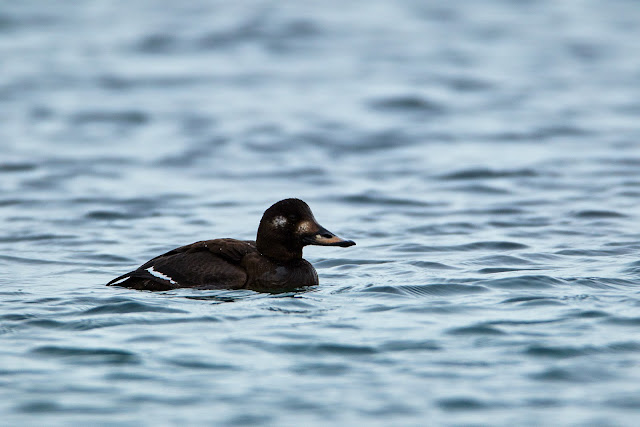


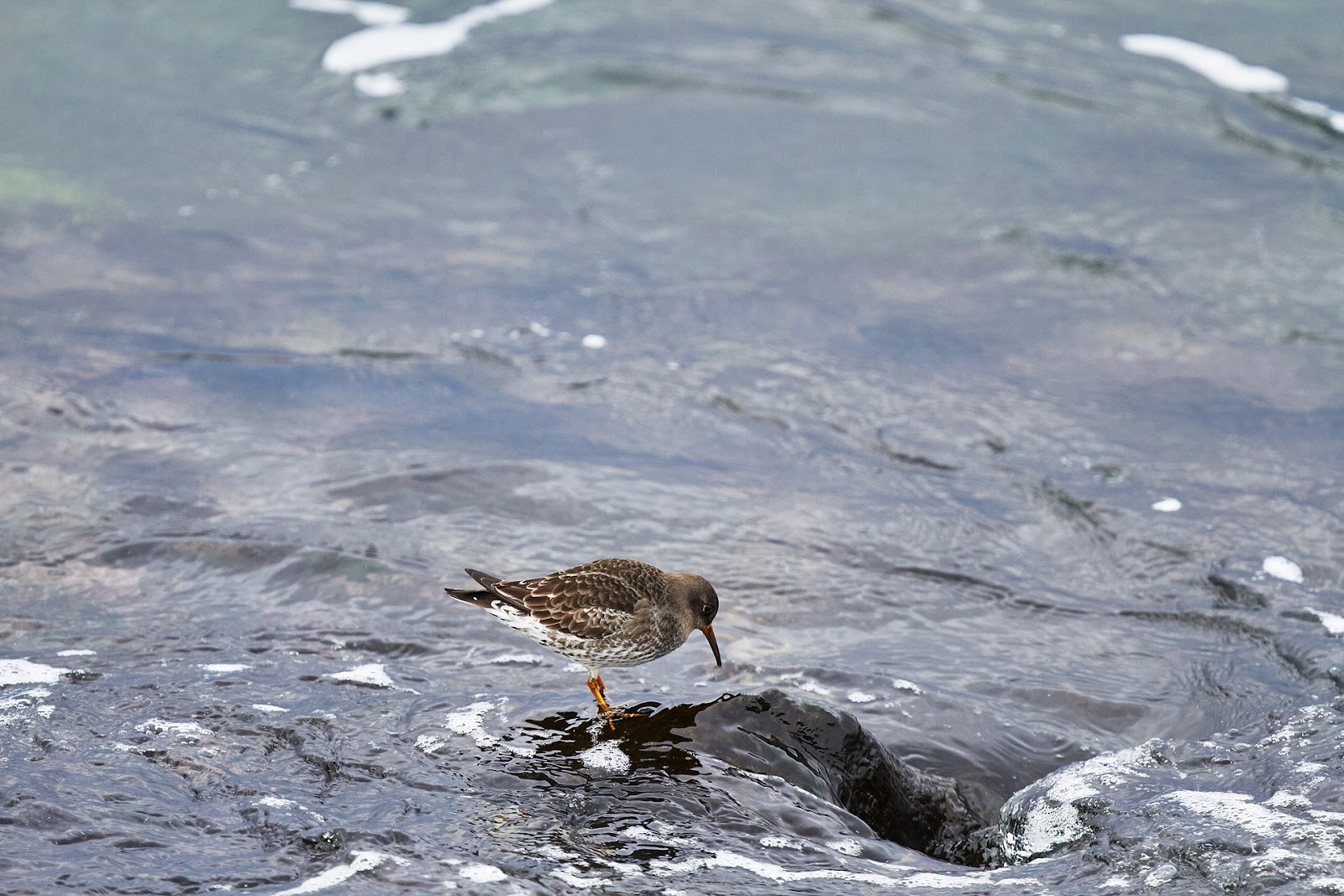
My second stop was Sele Havn. Here I bumped into a Longtailed Duck right in the harbor, Purple Sandpiper on the outer harbor walls jumping in and out of the surf, three flotillas of Mallards further out to sea as well as a juvvy Black Guilemot just outside the harbor walls. Nice finds indeed! I've been trying to get a decent shot of the Longtailed since I first saw them though a scope at Reve Kai over the next bay sometime back.


As I swing around on my way back home, I stopped by Granebukta connected to the waters of Harsfjord near Three Swords. This is a great spot for wintering species. You do however have to put up with people traffic and their dogs and in better weather with windsurfers and fly fishermen. So I normally stop here only during the weekdays on my off days, early mornings or late afternoons just before sunset. Common Widgeon, Mallard, Velvet Scoter, and waders are easily seen here and in reasonable numbers. Early morning and late afternoon will afford you closer views as the species roost closer to shore.


Notwithstanding the weather which wasn't too bad but could be better, the birding itself was great. I bagged several diving sequences of Velvet Scoter that I wanted as well as a rather decent grab shot of the beautiful Longtailed Duck. The Black Guillemot was a big fat Friday bonus. I definitely went home a happier birder!
My first stop was Risavika Havn, approximately 30 mins from home. There were rafts of Goldeneyes and Mallards far across the bay. About 20-25 Grey Heron in flight spooked by a big raptor which I couldn't identify. And there they were two seals in the water right in front of my set-up ... which quickly answered my question as to why the ducks were so distant today as opposed to a couple of weeks back.
I have been to this spot several times over the years, Common Scoter, Velvet Scoter, Grey Heron, Mute Swan, Common Widgeon, Mallard, Cormorant are the usual suspects spotted around the bay. The herons actually roosts on the trees and rocks on little islands nearby. The seals too have been spotted before in the bay. On this session I also saw a pair of Redbreasted Merganser foraging close to shore. These birds are not usually present in big numbers but enough to sustain a birder's interest, well mine at least.


I think the best from this spot are the sea ducks ... both the Velvet Scoter (Melanitta fusca) and the Common Scoter (Melanitta nigra). They too are not present in great numbers however those that are present which usually number less than ten individuals afford very close views especially for photography without any elaborate hides and what not. They are usually scattered over the small bay, but always one or two close to shore.
There are times when one or two curious individuals (ducks) would come quite close for great views on the 600mm lens coupled with a 1.6 crop factor camera. Normally they are far at the start, but once you are settled in, one or two would make a close swim by feeding and foraging along as it does so, definitely within a 10m range.


My second stop was Sele Havn. Here I bumped into a Longtailed Duck right in the harbor, Purple Sandpiper on the outer harbor walls jumping in and out of the surf, three flotillas of Mallards further out to sea as well as a juvvy Black Guilemot just outside the harbor walls. Nice finds indeed! I've been trying to get a decent shot of the Longtailed since I first saw them though a scope at Reve Kai over the next bay sometime back.


As I swing around on my way back home, I stopped by Granebukta connected to the waters of Harsfjord near Three Swords. This is a great spot for wintering species. You do however have to put up with people traffic and their dogs and in better weather with windsurfers and fly fishermen. So I normally stop here only during the weekdays on my off days, early mornings or late afternoons just before sunset. Common Widgeon, Mallard, Velvet Scoter, and waders are easily seen here and in reasonable numbers. Early morning and late afternoon will afford you closer views as the species roost closer to shore.


Notwithstanding the weather which wasn't too bad but could be better, the birding itself was great. I bagged several diving sequences of Velvet Scoter that I wanted as well as a rather decent grab shot of the beautiful Longtailed Duck. The Black Guillemot was a big fat Friday bonus. I definitely went home a happier birder!
Sunday, May 5, 2013
Purple Sandpiper at Tungeneset
Went out on a hunch to Tungenes Fyr, Randaberg this morning. Wader season should be starting soon, why not go check out some places near to home. So far it's proven that season's starting late this year ... Lista and other sites closer hasn't revealed much in terms of waders.
So off I went equipped with the scope set up and the trusty 400/5.6. And I wasn't dissappointed. After almost a year in Norway, I finally saw my Purple Sandpiper.
From Wikipedia,
"Adults have short yellow legs and a medium thin dark bill with a yellow base. The body is dark on top with a slight purplish gloss and mainly white underneath. The breast is smeared with grey and the rump is black. They measure 20–22 cm (7.9–8.7 in) in length and 42–46 cm (17–18 in) across the wings, and weight is from 50–105 g (1.8–3.7 oz).[2]


So off I went equipped with the scope set up and the trusty 400/5.6. And I wasn't dissappointed. After almost a year in Norway, I finally saw my Purple Sandpiper.
From Wikipedia,
"Adults have short yellow legs and a medium thin dark bill with a yellow base. The body is dark on top with a slight purplish gloss and mainly white underneath. The breast is smeared with grey and the rump is black. They measure 20–22 cm (7.9–8.7 in) in length and 42–46 cm (17–18 in) across the wings, and weight is from 50–105 g (1.8–3.7 oz).[2]
Their breeding habitat is the northern tundra on Arctic islands in Canada and coastal areas in Greenland and northwestern Europe. They nest on the ground either elevated on rocks or in lower damp location. The males makes several scrapes; the female choose one and lays 3 or 4 eggs. The male takes the major responsibility for incubation and tends the chicks. The young feed themselves."


Purple Sandpiper / Fjaereplytt / Calidris maritima
The nice part was that these birds weren't as easily spooked as some of the other waders I've observed, they were tolerating my presence long enough to make some proper shots of them. I actually followed a flock as it foraged along the rocky shores passed the lighthouse. I was glad that when they finally all took off, it was the dog that scared them away. It was an exhilarating morning to say the least.
Subscribe to:
Posts (Atom)