Pages

Saturday, September 1, 2012

Off to Jaeren again

With the encouraging number of waders and other birds seen last weekend, I thought it'd be a great idea to lug the big gear to the beach to see if an improved image can be made of several of the species seen then. I left the house at approximately 0545hrs and was in Revtangen by 0615hrs, even the cows were still chewing their cud waiting for sunrise.

A very nice landscape emerged as the sunlight slowly crept across the coast.

The boulders here seemed teeming with birds on previous visits, this weekend I was only accompanied by a Common Eider, several seagulls and passing cormorants.

It's low tide day which I wasn't expecting. It has been said that watching waders is best during high tides when they have less space to spread around; they also have the tendency to roost or rest when tide is highest, best times to find the highest concentration of waders for some places.

Both  the Southe and North beaches seemed much quieter than the previous week; the seagulls, crows and cormorants, common eiders were there. There weren't many waders except for a group of 10 Common Ring Plovers  encounter along the way to the North beach.

Once settled in between a big rock and a hard place, which was to be my station for the day, I unpacked and rigged up  the gear waiting for the waders. It was quiet. There were waves and waves of cormorants flying past in a southerly direction; seagulls squawking overhead and small little passerines moving northwards.

The elegant looking eclipsed male Common Eider which spent the morning foraging nearby completely not bothered with my presence.


Several small groups of Whimbrels flew past from the bluff probably from their roosting site somewhere along the Orrevatnet. More cormorants. Even the Dunlin were scarce. I sat there amusing myselft with some snails and admiring some very neat rocky beach landscape.

After close to two hours communing with the large boulders and devouring half a banana with only a few shots of an eclipse male Common Eider, my time was up. The waders were flying past without stopping; the ones that did stop were rather too few (probably two) which got lost amongst the boulders.


The cormorant which decided to land elsewhere. His brethren flew above the waves making their way south in big numbers (hundreds) that morning along the same beach.

The rounded rocks which scattered all over the beach, willing subjects.

This Ruddy Turnstone was the only one spotted on the way back to the car, it was kind enough to stop for 5 seconds and afford me the best shot of the day with the 600mm.


Nevermind, there's always next week. On the way back to the car I bumped into a willing Ruddy Turnstone which was kind enough to pose for a photo of the week!

Words and images by N. Abghani/NO-2012.

Sunday, August 26, 2012

Wader tripping to Jaeren, finally

After making several recce trips over the summer, I finally managed to make the first wader trip proper for the season to check out what's out there on the surf at Revtangen. Decided to travel light with only the digiscope set-up and the cameras without the 600/4.0 mm. Initially I was hoping to make some videos with the Sony attached to the scope.

I left the house bright and early 0645 hrs and was at the beach proper by 0715hrs, a total travel distance of 28km one way. The winds was extremely strong and surf looking very nasty when I arrived. There were surf spray all over. With the winds blowing so strong (must be gale 2.0 if not 1.5) all attempts at video failed miserably due to the high magnification factor and huge movements in the entire setup. It would have been even worst with the 600mm, it'll probably wobble like a sail. It was also quite cold!

Southern end of the Revtangen beach.

The northern end of the beach.

The particular patch at Revtangen held several clumps of waders but they proved very skittish. After about 1 hr on the south beach managed to get a good view of Sanderling, Common Ring Plover and Dunlin. Decided to move over to the northern end of the beach near the Revtangen birder's hytte. Also made the decision to pack up the digiscope set up and only move on with the backpack equipped with cameras and 400/5.6mm.

With the wind not letting up, it was a good decision to leave the scope in the car. An extra outer layer of heavy duty windbreaker made the cold a bit more bearable. Another crucial piece of gear that is a must is something warm for the exposed head.

Stationed myself by some big boulders on the beach and waited for the waders to come around. In less than 10 minutes the beach was attended to by Common Ringed Plover, Sanderlings, Ruddy Turnstones and Dunlins. By being still on the beach, the waders slowly approached to within 1.5-2.0 meters. The 400mm again proved it's in dispensability in these kinds of situations. It was light enough for handholding so does not require a tripod. Limited movements during phottaking encourages the birds to move closer and closer.

The surprising sight of the day was a pair of Peregrine Falcon regularly mobbing the waders at the water's edge. The beach being located below a 20m bluff provided excellent vantage point and lift for the tiny predators, the strong winds helped them in making their spectular sorties. Here the 400/5.6mm again proved it's usefulness in it's ability to make very quick maneuvers to get to capture an amazingly fast predator on the hunt.

These are some encouraging images made during the a few hours on the beach.

Ruddy Turnstone.

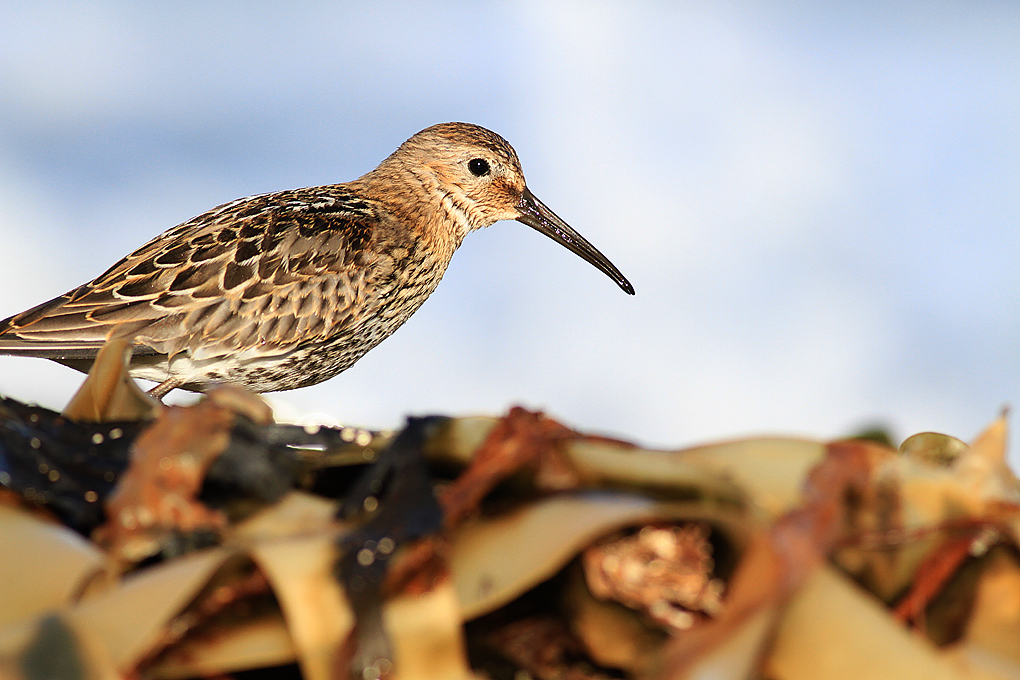
Dunlin, my first, apparently they are the most common wader in the and is apparently the standard for small waders in these part.

Sanderling.

Dunlin again, it move cautiously and slowly to withing 2m of where I was.

Peregrine Falcon overhead, there was a pair operating on the beach. These are magnificent predators and very fast.

There were a numbeer of turnstones working the same stretch of beach.

Revtangen seemed best to be worked out slowly, early morning seemed the best option. With such strong winds in the area (at least today) I am not sure if a hide or wraparound camo cloth would be ideal. It'll definitely be a challenge to keep these things still in the face of such windy conditions. Dress camo and dress warmer. What to do with the 600/4.0mm in these conditions? The groundpod perhaps to avoid big movements. Must also remember to wipe off salt from the equipment.

Looking forward to the next trip to this place.

Tuesday, June 12, 2012

Sandlo / Common Ringed Plover (Charadrius hiaticula)

With the arrival of the Gitzo and Wimberly in the airfreight last Friday, it seemed a waste not to revisit Tungenes again for the Nothern Wheater and Common Ringed Plover or whatever else the area might have on it's shores.

We reached the site in about 32 minutes from home greeted by a bright but cloudy weather. There was nobody else on location other than several families visiting the lighthouse, I guess it was still too early for summer trippers.

The plover seemed more skittish than the previous visit but stayed around within safe distances. It made several alarm calls and executed broken wing ruse to lure us away from their expected location.


Only realised that there was a nest nearby after observing one of plovers sitting on the grassy part of a patch not far from where we set up the tripod. A bonus definitely to be able to observe it on the nesting, what might also be young plovers in a few weeks time.

There were other birds in the area as well. Northern Wheater was busy bringing insects and larvae to it's nest to feed it's brood. It too had an elaborate ruse to confuse would be predators to the actual location of the nest. The situation is better for the wheater since the nest is well hidden, as opposed the the plover's which is well out in the open and rather prone to disturbance.


There were also several families of Common Eider at the water's edge each with 4-5 fluffy ducklings. The ducklings were busy foraging just below the water. It looks to be going well for the ducks, hopefully it'll be the same if not better for the plovers.

Monday, June 11, 2012

On Bru with the family

Even with the maps all planned out and GPS turned on, we picked a "wrong" from behind some horse shed which led up right to a hill, considerably higher than the surroundings. I wasn't sure that we were even supposed to be there but since the farmhands that were around didn't seem to object ("Bloody tourists!" probably went through their mind at least once I suspect).

We saw the usual birds: Meadow Pipit, White Wagtail, Northern Wheater, Greenfinch (quite a few), Northern Lapwing, Oystercatcher, European Starling, and Black-eared Wheater. Gulls were overhead. One beautiful bird was the Rosenfink / Common Rosefinch Carpodacus erythrinus.


The two routes we took on Bru, we ain't done yet I assure you.


Along a different route on the way back we saw Great Cormorant, a group of Red-breasted Merganser, and Common Eider in the water. We also went back to the rock near the bridge to gawk at Arctic Tern and incidentally spotted a Redshank in breeding colors by the waters edge.

This is our first and definitely not last visit to the locality. The underground tunnel was a bit scary to say the list, but hopefully with more trips we'll get use to it soon enough.

Friday, June 8, 2012

Walkabout Harfsfjord water's edge

After dropping off the kids at ISS on Wednesday, I found myself alone on my own finally after almost two weeks in my new playground. What's a birder to do alone on their own : birdwatch of course except this time without pesky kids around.

I started off from Kiwi supermart at the start of Harfsfjord Bru and walked 4kms along the water's edge. A few nice birds popped up, one was new to me.

A common sight on the water's edge all over these parts, Oystercatcher, most often you'll hear them first.

A Great Cormorant suddenly popped out of nowhere looking a bit annoyed at the presence of an intruder (yours truly).

A juvenile Siland / Red-breasted Merganser (Mergus serrator) also decided to join our party.

He made some awkward gesture, popping it's head, opening it's beak ... silently without any ensuing sound.


The Meadow Pipit was more than noisy. This tiny bird kept flitting about excitedly around me, most likely it's got a nest of young someplace nearby.

Common Eider, male and female just under the Harfsfjord Bru, apparently a guaranteed site for this species.

The 3.68km route I walked in my loafers.

It's definitely satisfying to watch all these without hindrance, however these days it feels much more gratifying to be able to share it with the youngins despite their whining. For this short walkie they'd probably appreciate the view, the birds and the numerous picturesque pit-stops; I'm not so sure if they'll appreciate the 4km distance walk with their short legs though.

Tuesday, June 5, 2012

Tungenes

Hot on the trails of the Rodnebbterne / Arctic Tern (Sterna paradisaea) at Sokn, I figure a second trip to Tungenes was in order. This time we entered in an actual address into the GPS: "Tungenesvein 217".

We made it over in 30mins from home to be received by a drizzling morning rain. Odin be with us, the drizzle stopped after about 5 minutes, the sun rolled in bringing along blueskies and thick white clouds.

Immediately upon opening the car door we were greeted by a friendly Linerle / White Wagtail Moticilla alba and almost in succession a pair of Rodnebbterne hunting at the little harbour and Storskarv / Great Cormorant Phalacrocorax carbo flying across. We had two pairs and a half of storkarv that single morning!

And it didn't stop there ... there were more on the rugged coast as the morning progressed including an Aerfugl / Common Eider  Somateria mollisima bobbing up and down at sea! The Oystercatcher and seagulls are of course all over the place.

White Wagtail with an insect for the young.

A little fish for breakfast for the Arctic Tern.

Arctic Tern in a most graceful flight along the rocky coast.

A pair of Great Cormorant making a fly-pass. We ended up seeing five of these at Tungenes.

A male Steinkvett / Northern Wheater Oenanthe oenanthe with a treat for the youngins.

This female Northern Wheater went through a complex flight plan everytime it brings food to the nest to deceive potential predators and draw them away from the nest. All the while we were watching not five metres away.

The last icing for the day has to be what we saw as we slowly ambled towards the car, a pair of Sandlo / Common Ringed Plover Charadrius hiaticula. I spent a good 20 minutes admiring this confiding plover as it went back and forth towards me.

My last  actual sighting of this beautiful plover was back in 2009 during our DIY Wader Workshop in Kota Kinabalu, Sabah. The single sighting was made by our group at Lok Kawi Beach. Over the years one single sighting of this plover is made every year at Lok Kawi by birder friends in KK.

Tungenes rocks! There's still Bo the explore, not to mention the entire rocky coast north of Tungenes, betcha there're some niceties there too.

Monday, June 4, 2012

Rodnebbterne / Arctic Tern (Sterna paradisaea)

Maps ready stamped in our minds, routes perfectly etched. This is our foray in an attempt to slowly complete our house and my fairly mild attempt at doing a recce of surrounding birding sites in preparation for days to come. So first we pinned IKEA, Kvadrat ... then a look and see around Tungenes and Boraunen.

At least that's what we thought anyways. The shopping at IKEA went through harmlessly enough followed by lunch and some more shopping. By 13:40hrs we left the shopping grounds heading for Bergen and the planned turn-off at Randaberg to find the lighthouse at Tungenes.

We failed to make our turning and ended up in a very long dimly lit tunnel with fast moving cars underneath Bru for what seemed like a mini eternity and emerged light starved in the middle of Sokn. Still dazed we quickly rushed to what looked like a parking lot in the first open space we saw. No lighthouse today!


We found a nice big rock by the shore just beside the bridge to rest. Other the view there were several flitting birds around the same place. Over yonder on another rock in the sea we could see more birds, seagulls, terns and a swan among them. There was also a duck somewhere in the midst. 

Close to where we were sitting was a pipit, it was calling forlornly and above, a tern expertly doing acrobatics in strong winds. The pipit turned out to be Meadow Pipit and the tern was Arctic Tern. Two new birds! There's a reward afterall.

Our foray didn't exactly ended up where we wanted, but it could not have been a better place. IWe stumbled on a great spot we weren't initially planning for. Rodnebbterne / Arctic Tern Sterna paradisaea  is a new bird for me, and so is the Heipiplerke / Meadow Pipit Anthus pratensis. It was a good day to be taking wrong turns.

Well, we did turn around and made it to Bo and almost to Tungenes, we'll save those for another sunny day.